

Buying a Villa in Thailand in 2026: A Foreigner's Real Options
By Fred von Keller · 23 July 2026
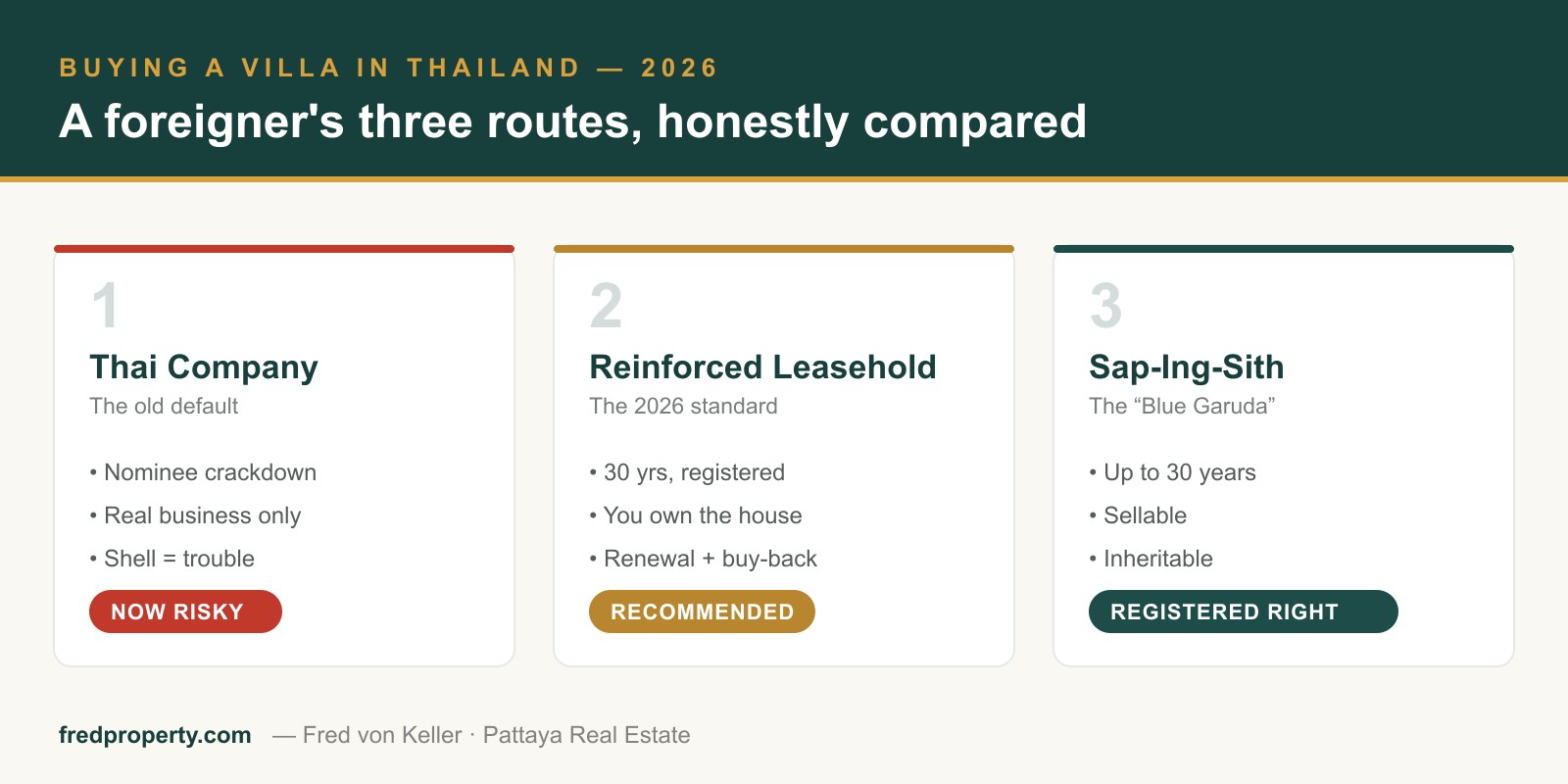
Foreigners cannot own land in Thailand. That single rule shapes every villa purchase on the Eastern Seaboard — and it's also the source of most of the bad advice you'll hear around a pool table in Pattaya.
The rule hasn't changed in 2026. What has changed is enforcement, and that changes which routes are safe. So here are a foreigner's real options for buying a villa today — including the one I now generally advise against.
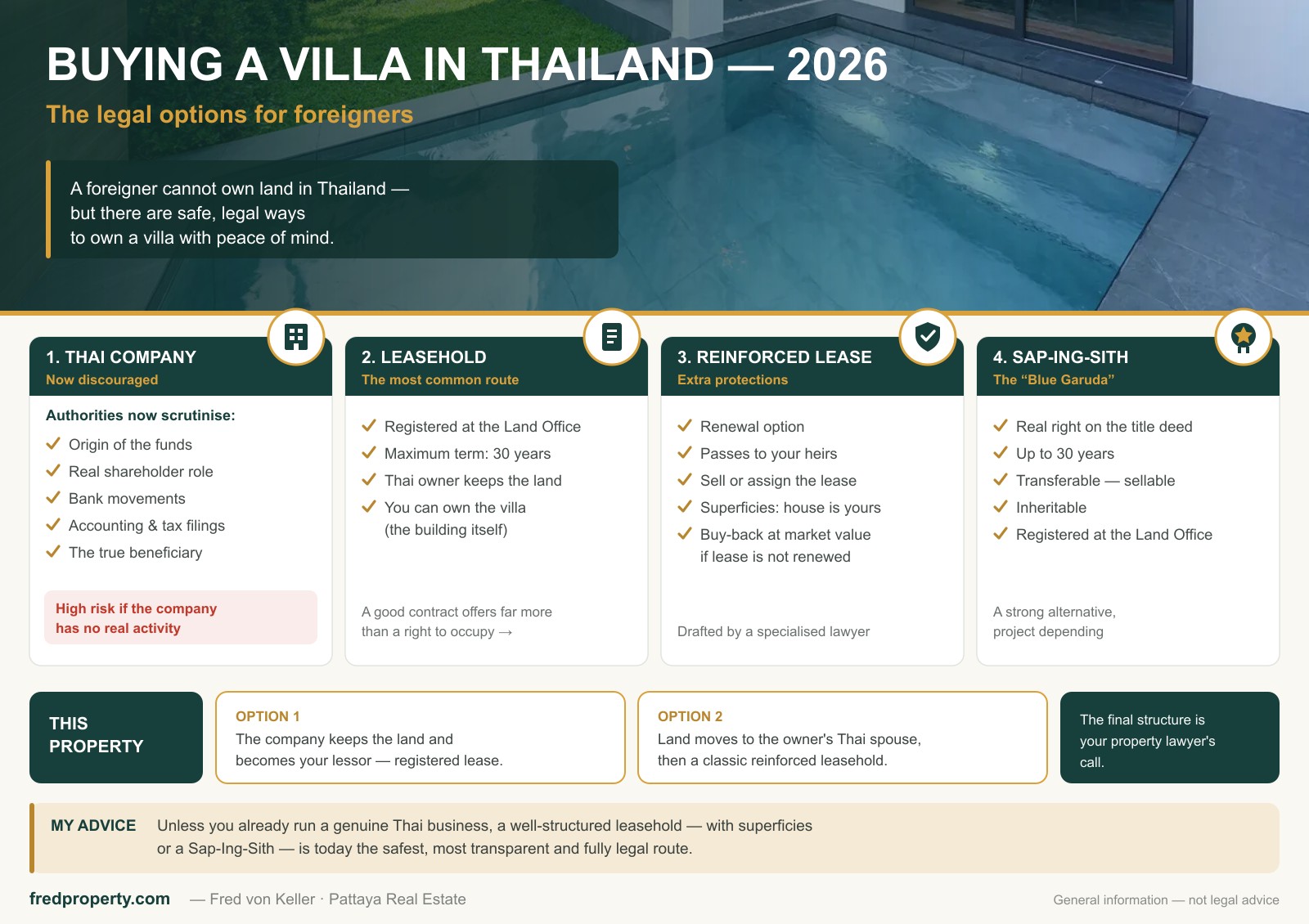
1. Buying through a Thai company: the old default, now discouraged
For many years the standard move was to buy a villa through a Thai limited company — 51% held by Thai shareholders, 49% by the foreign buyer, with the foreigner controlling the company in practice.
Today that route is far riskier than it used to be.
The Thai authorities have launched a sustained campaign against so-called nominee companies — companies created purely to get around the foreign land-ownership ban. Investigators now look at:
- where the Thai shareholders' money actually came from;
- whether those shareholders play any real role in the company;
- the company's bank movements;
- its accounting and tax filings;
- and who the true beneficiary of the company is.
In plain terms: a company can no longer be an empty shell that exists to hold a plot of land.
To be clear, a company remains perfectly legal if it runs a genuine business, keeps proper accounts, and has real Thai shareholders who invested their own funds. What's in the authorities' sights is the old-style nominee structure — and thousands of villas in Pattaya sit inside exactly that kind of structure. I covered the enforcement campaign in detail in my article on the nominee crackdown and what it means for house owners.
My position in 2026: unless you already operate a real, active business in Thailand with legitimate shareholders and full accounting, don't buy your home through a company.
2. Leasehold: the standard solution today
For a foreign buyer who wants a villa, a registered leasehold is now the most reliable route.
The lease is registered at the Land Office for a maximum term of 30 years. That registration matters: it's stamped on the land title itself, visible to anyone who checks, and enforceable against whoever owns the land.
A bare 30-year lease, though, is just a right to occupy. A well-drafted lease can be considerably more than that.
3. The reinforced leasehold
With a specialised lawyer, the contract can be built out with real protections:
- an option to renew the lease for further terms;
- the right to pass the lease to your heirs;
- the right to sell or assign the lease to a new buyer;
- and — the important one — legal separation of the house from the land, usually through a registered right of superficies.
That last point deserves a sentence of its own, because it changes what you actually own:
- the Thai landowner keeps the land;
- you, the foreign buyer, legally own the house standing on it.
Your name, on a registered right, for the physical building. This structure is now widely used to secure villa purchases by foreigners, and it's the difference between "renting for 30 years" and genuinely owning your home.
One honest caveat, because you should hear it from your agent and not discover it later: renewal options and transfer rights are contractual promises, not registered guarantees. They're only as strong as the drafting — which is why the lawyer is not the place to economise.
4. The buy-back clause
A further protection worth asking your lawyer about: a clause providing that if the lease is ultimately not renewed at the end of its term, the landowner must buy the house back from you at fair market value.
This protects the core of your investment. The worst-case scenario stops being "I lose the house I paid for" and becomes "I'm paid out at market value." Again — this is a contractual protection, and it works only if it's carefully drafted.
5. The Sap-Ing-Sith ("Blue Garuda")
Thailand also offers a newer instrument: the Sap-Ing-Sith, often called the Blue Garuda after the seal on its title document. It's a real property right — stronger in nature than a contractual lease — registered at the Land Office:
- duration up to 30 years;
- freely transferable — you can sell it;
- inheritable by your heirs;
- officially registered on the land title deed.
Not every project offers it, and it's still less common than leasehold — but where it's available, it can be a genuinely interesting alternative, because transferability and inheritance are built into the right itself rather than depending on contract clauses. A useful developer's explanation of modern leasehold structures is ESS Developments' guide to leasehold ownership.
6. A real example from my own listings
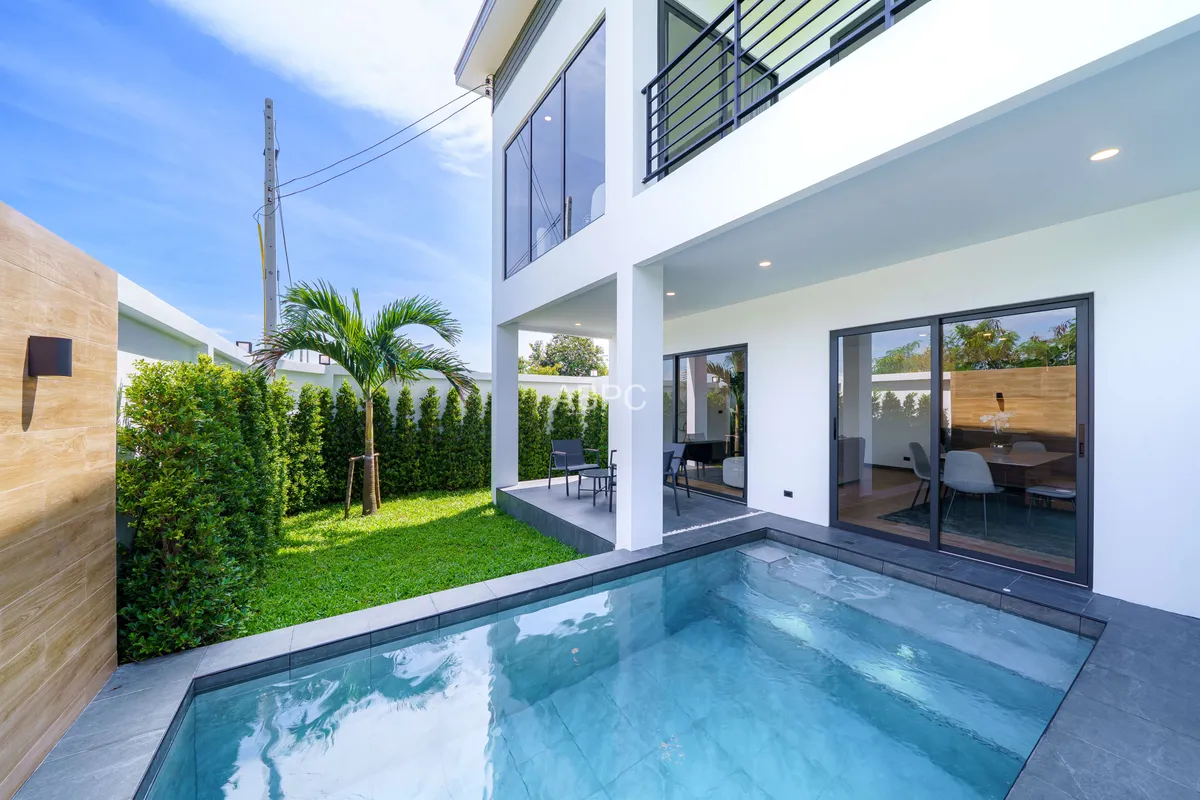
Theory is fine; here's how it plays out on an actual villa. One of my current listings — a modern 4-bedroom pool villa at Lake Mabprachan — is currently held inside a Thai company. For a foreign buyer, there are two clean ways forward:
Option 1 — the company becomes the lessor. The company keeps the land and grants you a registered lease. A Thai company that owns land can legally lease it to a foreign buyer; combined with a superficies right for the house, you get the full reinforced-leasehold structure described above.
Option 2 — restructure before the sale. This particular owner is married to a Thai national and is flexible on structure. The land can be transferred into his wife's name before the sale, followed by a classic leasehold to the buyer.
Which option is better isn't a matter of opinion — it's exactly the question the law firm handling the transaction is there to answer, based on the buyer's situation.
Hot propertyModern 4-Bedroom Pool Villa at Lake Mabprachan, East Pattaya
฿9,900,000
 1 / 30
My advice
In 2026, I generally advise foreign buyers against acquiring a villa through a Thai company — unless you already own a genuine operating business with legitimate shareholders, complete accounts and real commercial activity.
For everyone else, a properly structured leasehold — reinforced with a superficies right for the house, renewal and transfer clauses, and ideally a buy-back provision — or, where available, a Sap-Ing-Sith, is today the safest, most transparent route, and the one that actually complies with Thai law.
Two rules I give every villa buyer, whatever the structure:
- Use an independent, specialised property lawyer. Not the seller's lawyer, not the developer's — yours. The entire strength of a leasehold lies in its drafting.
- Walk away from anyone who tells you the company route is "no problem, everyone does it." That was last decade's advice, and the enforcement climate has moved on.
If you're looking at a villa — mine or anyone else's — and want an honest read on how its ownership can be structured for you, send me a message or read more on what your budget buys in Pattaya. I work in English, French, German and Spanish, and I'll tell you when a structure smells wrong, even if it costs me the sale.
This article is general information about the Thai property market as of 2026, not legal advice. Structures must be reviewed case by case by a qualified Thai lawyer.
 Featured development
Mabprachan Lake · East Pattaya
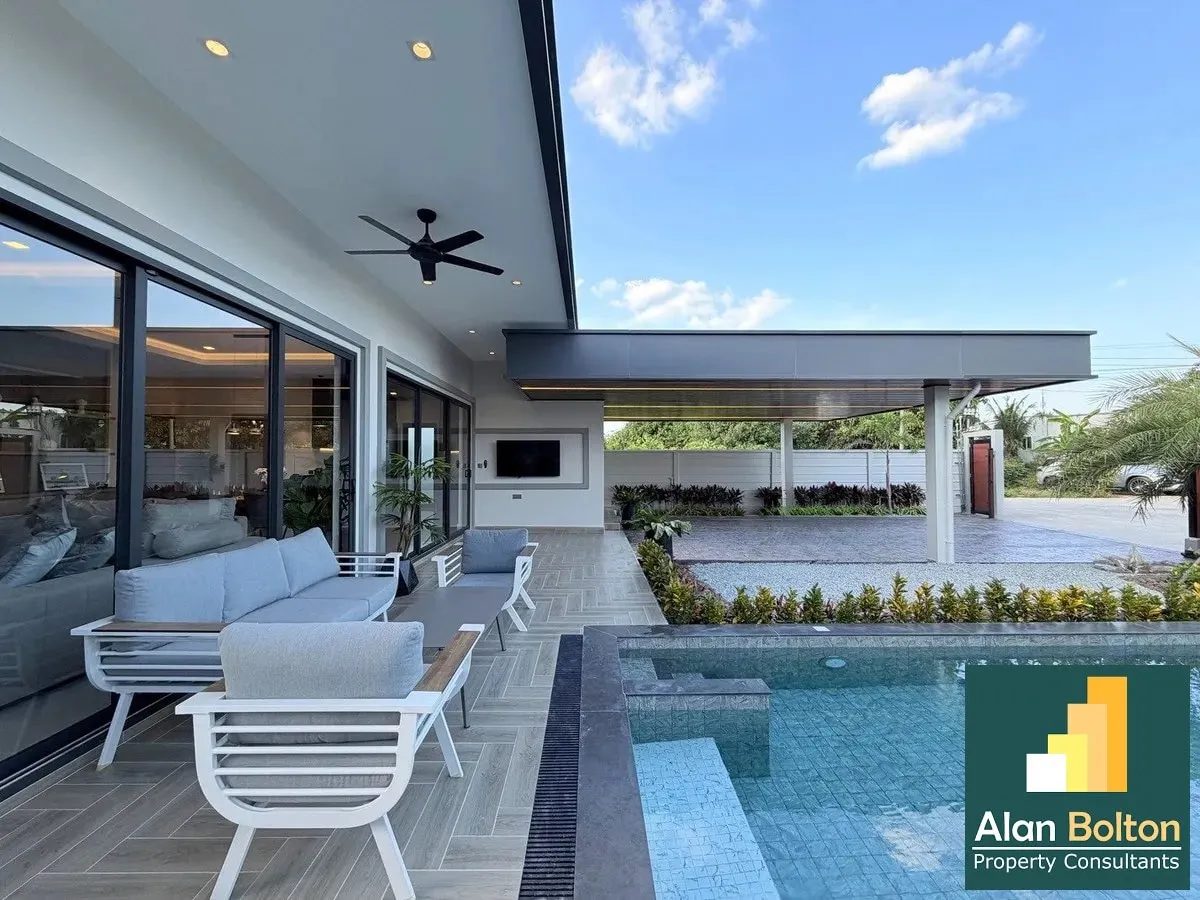
Zensiri Lakeside Mabprachan
Lakeside luxury pool villas near the best schools and golf
In partnership with ESS Developments

Questions about the Pattaya market?
Call or message me directly — I answer personally, usually within the hour.